


Climate Security : Kribi Acquires a Meteorological Radar
Dernière mise à jours il y'a 8 moisUnder the joint signature of Jean Ernest Masséna Ngallé Bibéhé, Minister of Transport, and Guy Emmanuel Sabikanda, Mayor of the seaside resort, a framework collaboration agreement was sealed on Thursday, January 22, 2026, transforming the Ocean City into a first-rate technological sentinel. By linking the Kribi Urban Council (CUK) to the National Meteorological Directorate’s network, the government is not merely signing an administrative document; it is deploying a digital shield over a growth pole whose coastal vulnerability now demands surgical precision.
Lire aussi : Infrastructures routières : La section Edéa-Dizangue prend forme
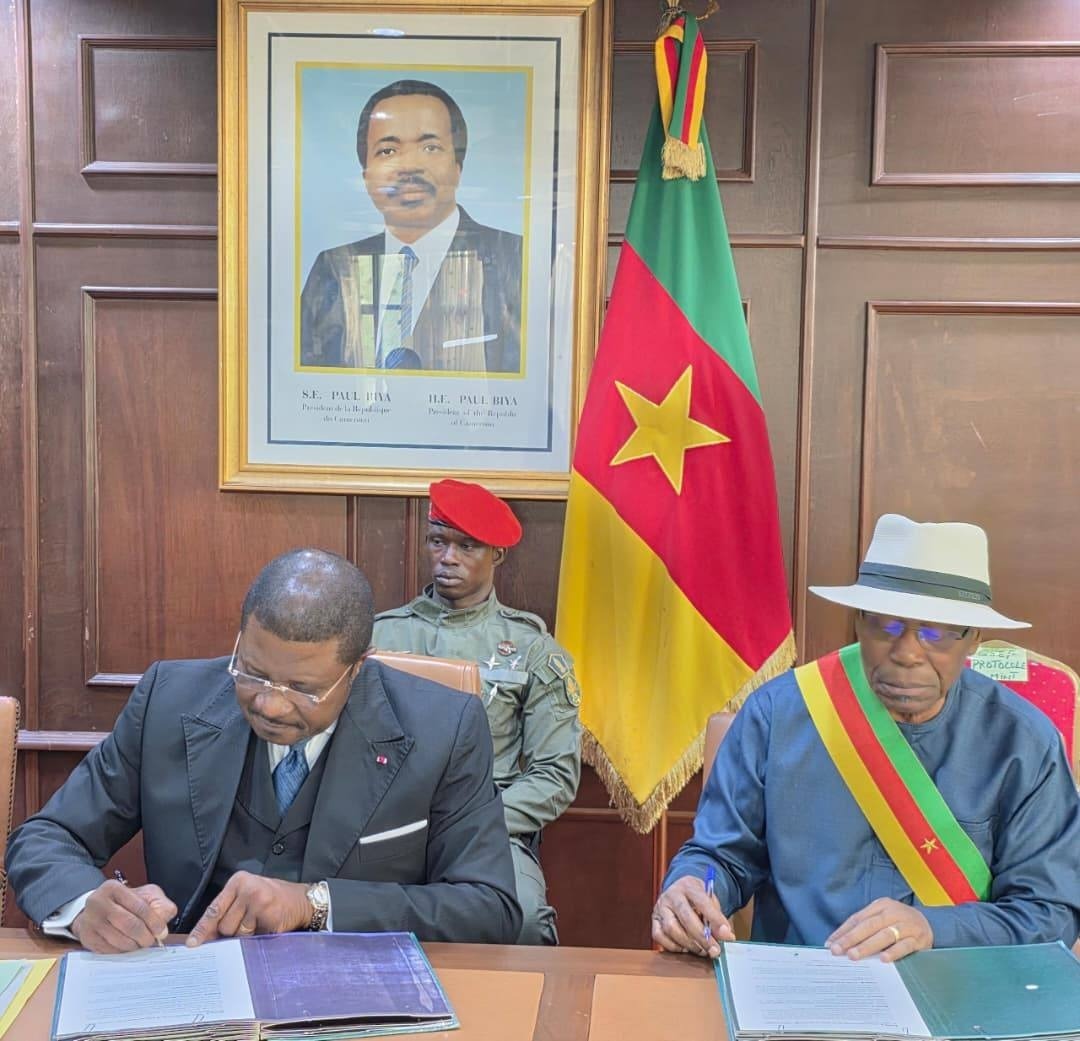
This synergy of actions is part of a global modernization dynamic for surveillance infrastructure. The Kribi meteorological station has recently undergone a technological rejuvenation with the installation of latest-generation sensors capable of transmitting, in real-time, fluctuations in atmospheric pressure, hygrometry, and cyclonic winds. For Kribi, whose economy relies on port activity and tourism, having access to reliable data is no longer a luxury but a necessity for economic survival. The agreement provides not only for the collection and processing of this information but, above all, for its dissemination among municipal agents for optimized natural disaster management.
The Minister of Transport, faithful to the vision of sector modernization, is thus extending a security web that has already proven its effectiveness in Douala and Bafoussam. This technical assistance to Decentralized Territorial Collectivities (CTDs) democratizes access to climate information, once confined to expert circles. In Kribi, this collaboration will enable better planning of coastal urbanism and protect the massive investments made in the industrial-port zone. The capacity building of municipal personnel, provided for in the agreement, guarantees that every meteorological alert will be translated into concrete prevention measures on the ground.
Beyond the equipment, a culture of anticipation is taking root. Expressing his gratitude for the diligence of the municipal teams, Jean Ernest Masséna Ngallé Bibéhé reaffirmed that resilience against extreme events—increasingly frequent in the Gulf of Guinea—requires absolute mastery of data. At a time when climate change is redrawing risk maps, Kribi positions itself as a smart city model, capable of listening to the sky to better protect its land.
CK

bernardo carlos ndjomo
Commentaire(s) du post
Articles similaires






Floyd Miles
Actually, now that I try out the links on my message, above, none of them take me to the secure site. Only my shortcut on my desktop, which I created years ago.